Monday, 10 April 2017

Articulating Outcomes: Thinking Like an Assessor


By Zalino Bona


Standard: The student will ask and answer questions before, during, and after reading in order to gain new information and give purpose and focus.

Source: Reading Literacy, Grade 4 (Quality Schools International)


Formative Assessment:

Formative assessment is ongoing, informal assessment that happens in class after the lesson is taught.


The big idea in this unit: Good readers ask questions.

When readers ask questions, they engage with the text in a deeper way, and it helps them to better understand what they are reading.

To ensure that students learn to ask questions before, during and after reading a text, I will begin by explaining how good readers ask questions to get new information, and modelling it as I read an informational text aloud. I will think aloud as I read, asking questions and writing them down on sticky notes. After a couple of pages, I will ask students to join in with their questions. Then students will practice it independently as they read a text and write their questions on sticky-notes. The questions will then be transferred to a graphic organizer. Formative assessment takes place as I read their written work and give feed-back.

“One of the strongest positive influence on achievement occurs when students get formative feedback that they immediately can apply.” (Linda Darling-Hammond))


1
The student will demonstrate their ability to ask purposeful questions by using right vocabulary:
What I will Look for…
How I will know the student is meeting the standard
Right vocabulary using question words


The student uses who, what, when, where, why, how and I wonder to ask questions about the text during class discussions and his/her written work.
For example, the student uses ‘Who?’ What? Where? When? etc. to ask questions about characters, events, setting and time.

 2
The student will demonstrate their ability to effectively use a graphic organizer to collect information: ten to fifteen questions before, during and after reading a text, and answers to some questions.
What I will look for…
How I will know the student is meeting the standard
·         Questions generated before, during and after reading the text
·         The graphic organizer filled out with questions and answers.

·         Evidence of ten to fifteen questions in the graphic organizer
·         Evidence of answers to some of the questions.

Some strategies I would use for formative Assessment:

-          Observation: walking around and observing to check for learning

-          Think-Write-Pair-Share (Students will discuss and refine their questions by working collaboratively with their peers)

As I work on giving feedback, I’ll need to ensure that I understand my students’ thought processes, and not just check their answers. What have they understood and what are they having trouble with?


Summative Assessment:
Summative assessment is assessment that takes place at the end of an instructional unit. Student learning is evaluated by comparing it against specific standards or benchmarks.

At the end of the unit, the student will demonstrate their understanding of the unit by:

1.      Explaining verbally, or by writing a paragraph, how asking questions help them to better understand what they read.

2.      Producing evidence of effective use of graphic organizers by writing ten to fifteen questions they asked before, during and after reading of at least three informational texts. (They can pick one as their best work for the final assessment).

3.     Categorizing their questions, identifying important questions and explaining how and why these questions help them to better understand the text.


At the end of the unit, students will categorize the questions on their graphic organizer, identify important questions and explain (verbally or in a written paragraph), by giving an example, how those questions help them to better understand the text.
What I will look for…
How I will know the student is meeting the standard
·         Graphic Organizer filled out with questions and answers
·         Questions categorized into important and interesting.
·         Oral or written explanation of how important questions help them to better understand the text.
·         An example of how a question helped them to better understand the text.
·         The student has a graphic organizer filled out with questions and answers
·         The student categorized the questions and identified important questions.
·         The student explained how important questions help them to better understand what they read.
·         The student gave an example of how a question helped him/her to better understand the text.


How Will students reflect upon and self-assess their learning?

The student will self-assess his/her performance by using the following rubric:

Objective
                “B”
                 “A”
The student will explain how asking questions help him/her to better understand what they read.

I can explain how asking questions help me to better understand what I read.
I can explain, in a written  paragraph, how asking questions help me to better understand what I read.
The student will use a graphic organizer to write ten to fifteen questions.
I have at least ten questions on my graphic organizer.
I have fifteen questions on my graphic organizer.
The student will categorize questions into important and interesting questions.
I can categorize my questions into interesting and important questions.
I can categorize my questions and explain how the important questions help me to engage with the text.
The student will identify important questions and explain how these questions help them to better understand the text.

I can identify important questions and explain how they help me to better understand the text.
I can identify important questions and explain how these questions help me to better understand a text by citing an example from the text.

The real test of learning comes when students are able to transfer their learning. As Dana Huff notes, “What is hard is making sure our students actually create true understandings and transfer their understandings.” The next step for students who finish early will be to create an ‘Asking Questions’ game or to generate purposeful questions which they will use to interview  a person and create a profile of that person using a digital tool.


References:

Darling-Hammond, Linda. (March 25, 2015). How Should We Measure Student Learning? 5 Keys to Comprehensive Assessment. Retrieved from https://www.edutopia.org/comprehensive-assessment-introduction
Hilliard, Patricia. (December 7, 2015). Performance-Based Assessment: Reviewing the Basics. Retrieved from https://www.edutopia.org/blog/performance-based-assessment-reviewing-basics-patricia-hilliard
Huff, Dana. (June 18, 2007). Understanding by Design: Thinking like an assessor. Retrieved from http://www.huffenglish.com/understanding-by-design-thinking-like-an-assessor/
What Is performance based assessment? Retrieved from
What is the difference between formative and summative assessment? Retrieved from https://www.cmu.edu/teaching/assessment/basics/formative-summative.html




Monday, 3 April 2017

Understanding and Applying the Standards

By Zalino Bona


One of the most important activities of a teacher is translating a standard into learning experiences. Unpacking a standard and backwards mapping help a teacher to do this.
Unpacking a standard is the process of translating a standard into lessons. Unpacking a standard helps me, the teacher, to be clear about what the standard means.

First, I need to identify:

-         What students need to know

-         What they need to do to demonstrate that they are meeting the standards.

I need to pay attention to:

Nouns: They help me to identify the concepts (character, plot, setting)

Verbs: They help me to identify the tasks (explain, compare, analyze)

Identifying the concepts and tasks help me to know what and how I need to teach the standards.

Big Ideas and Essential Questions: The big ideas are core concepts or principles. Identifying the big ideas helps me to know what is important and what I should focus on. Essential questions help me to think about those ideas. For example, a big idea in a fourth-grade reading class could be: Writers use diagrams to help readers understand important ideas. The essential questions could be: How do readers figure out what the diagrams mean? How do readers know what is important?

Backwards Mapping is basically a three-step process of creating a lesson plan by starting with the end/goals in mind. First, I need to identify what the desired goals are: what I want my students to know and be able to do. Next, I will decide how I will know when students meet those goals, and plan relevant instructional activities which will help students to reach the desired goals. 

How these two processes helped me understand the standards:


Learning about ‘unpacking a standard’ helped me to understand the process of translating a standard into a lesson. Identifying the nouns and verbs helps me to break down the standard into manageable pieces: what students need to know and do to meet the standard. Knowing how to translate a standard into a lesson helps me to be clear about what I need to teach and to design activities that will help students to accomplish the learning goals.

‘Backwards Design’ helped me to see the importance of having clear and specific goals. It helps me to think about what I should look at first; what I want to see at the end of the unit. For example, if a fourth-grade writing literacy standard is: ‘The student will use grade level, descriptive vocabulary words,’ at the end of the unit, I will look for evidence of descriptive words in the student’s writing. To help the student get to that level, I need to plan lessons and activities which will help the student to learn descriptive words at grade level and to use those words in his/her writing.

Backwards mapping makes a lot of sense to me because it helps me to focus on what’s important. It pushes me to think more deeply about my lessons. While developing lesson plans, I need to be asking questions like: What is the goal of this unit? What should I do to help my students reach the goal? What should happen in the classroom? What skills would I need to teach? What would be the evidence that the desired goals have been achieved?
Learning about unpacking a standard has helped me to understand that it is important for me to be clear about concepts and tasks that are encapsulated in a standard. Backwards mapping helps me to think about how I would apply them in my classroom.
How is backwards mapping helpful? "We cannot say how to teach for understanding or which material and activities to use until we are quite clear about which specific understandings we are after and what such understandings look like in practice."(Wiggins and Mctighe) I think one of the main strengths of backward mapping is that it is goal-focused. Keeping the goal or a picture of the end design in my mind as I develop the lesson would help me to know what I would need to focus on to help students to accomplish that goal. I would also have a reasonably good idea about how I would assess their performance as well as align instruction to help my students to reach that goal.
I do have questions about how it will be implemented in my classroom. A question that comes to my mind is: Does this mean we may not cover all material? If we pick and choose only what is needed to reach the desired goals, will there be gaps in our students’ learning? When will they ever get to cover those sections that were skipped? Will this in any way influence the outcomes of tests they are required to take?


References:

Backward Design. (Updated: December, 2013). Retrieved from http://edglossary.org/backward-design/

Mctighe, Jay. (December, 2012). Common Core Big Idea 4: Map Backward From Intended Results. Retrieved from:


McTighe, Jay. (January, 2014). Greatest Lessons Learned. Retrieved from:  https://www.youtube.com/watch?v=KUtzbJtS1aY

Wiggins, Grant and McTighe, Jay. (n.d.). Understanding by Design: Backward Design. Retrieved from

.

Sunday, 2 April 2017

Standards and Backwards Mapping

By Zalino Bona

Subject and Grade: Reading Literacy Grade 4

Standard: The student will ask and answer questions before, during, and after reading in order to gain new information and give purpose and focus. 


Source of the Standard: Reading Literacy Grade 4, Quality Schools International
The Reading Literacy course is built on “best practice” research and is aligned with the Common Core Curriculum Standards.

Why I chose this standard:

Asking questions helps students to dig deeper and to be more engaged with the text. “Right questions foster powerful learning.” (Mathis, 2015) If we want our students to engage with whatever they read, we need to teach them to ask questions.
This reading strategy will enable students to engage in active inquiry, which is an essential element of college and career readiness. Good questioning skills go hand-in-hand with thinking, problem solving, decision making and judgment skills.
“Questioning is the strategy that propels readers on.” Stephanie Harvey (Scholastic)


Goals:                                         

Students will ask questions before, during, and after reading in order to gain new information and give purpose and focus.
Students will answer questions before, during, and after reading in order to gain new information and give purpose and focus.

Students will be able to independently use their learning to…                                         
  • Engage with the text by asking questions
  • Ask questions before, during, and after reading.
  • Get answers by asking specific and relevant questions
  • Get information by reading different genres of fiction and informational text

Understandings:                           
Students will understand that… questions can lead us to great discoveries.
  • Asking the right question is essential if you want to arrive at the right answer.  
  • Right questions lead to right answers.
  • We can learn to ask the right kind of questions

Proficiencies that indicate what students will be able to do when they finish this unit:
Students will demonstrate their ability to:
  • List the different words which can be used to ask questions and explain when each will be used (For example: Who? What? When? Where? Why, How, and I wonder.)
  • Ask questions before, during and after reading a text
  • Know how to ask questions using right vocabulary. Questions will vary depending on the genre and context.
  • Ask pertinent questions that will lead them to the right answers
  • Find answers to their questions in the text (and know that not all answers will be found in the text)


Assessments that will help me know students are meeting the standard (Performance tasks):

1.      Generating Questions: 

-          Students read a nonfiction text.

-          Use graphic organizer to write down questions before, during and after reading the text or
create a chart with questions asked before, during, and after reading the text


2.      Finding answers to Questions:

-          Were answers found in the text? Write down the answers. If answers were not found in the text, what would you do to find the answers?

3.      Using right vocabulary (Key words for asking questions)

-          Did the student use the right vocabulary? For example: who, what, where, when, why, how, and I wonder.  

4.      Transfer learning to real world experiences:

-     Generate questions for an interview to get information about a person or a profession or   

      life in the past

-     Conduct the interview

-     Create a presentation (poster or PowerPoint) about the person to share with the class


Learning experiences or activities I will use to help students meet the standard

Activity #1: Watch a video on Asking and Answering Questions:


Activity #2: Read a nonfiction text -  Who was Amelia Earheart
Students will use a chart to write their questions and answers.


1.      Explain that good readers ask questions before, during, and after reading to help them understand a story better.
2.      Read the book “Who was Amelia Earheart?” to the students.
3.      Questions Before Reading: Read the title, and the back cover and look at the illustrations and ask students to think of as many questions as they can. Ask them to write their questions on the chart.
4.      Questions while reading: Read the story to the children. Have them write down questions that pop into their minds during reading of the story.
5.      When you have finished reading the story, ask them to write down questions they have about the story.
6.      Students can then be assigned into groups and asked to share their questions and answers.
7.      Ask students to narrow down their question to three or four questions.
8.      Gather all students and have them share their questions.
9.      With help from the class, have students categorize their questions.
10.  Discuss the questions that are important vs. interesting, and have students focus on the important questions: those that help them to better understand the text.
11.  Student can also be asked to categorize questions into those answered in the text and those that would require more research.

 Activity #3 - Game: Who Am I?

“To get right answers, we must ask specific questions that will lead us to those answers.”

 A sticky-note with the name of an animal is placed on the forehead of a student. The student will ask ‘Yes/No’ questions to find out the name of the animal.

 (Sample Questions: Do I live in the desert? Do I have fur? Can I fly? Do I have four legs? etc.)

This activity will help students to learn to ask specific and relevant questions to find the answer.

Variations: Where am I? The name of a place can be used instead of an animal. The student will ask questions to find out where he/she is (city, country, etc.)


References:

Backward Design. (Updated: December, 2013). Retrieved from http://edglossary.org/backward-design/
Georgia, K.M. (August, 2015) Inquiry-Based Learning: The Power of Asking the Right Questions. Retrieved from:
https://www.edutopia.org/blog/inquiry-based-learning-asking-right-questions-georgia-mathis


Mctighe, Jay. (December 2012)Common Core Big Idea 4: Map Backward From Intended Results. Retrieved from:
https://www.edutopia.org/blog/common-core-map-backwards-jay-mctighe-grant-wiggins

McTighe, Jay. Greatest Lessons Learned. Retrieved from:  https://www.youtube.com/watch?v=KUtzbJtS1aY


Wiggins, Grant. (September, 2005). Understanding by Design: Overview of UbD and the design Template. ASCD.


Thursday, 9 March 2017

Applying Classroom Rules and Procedures


“When students do a good job at following rules and procedures, their willingness to be a positive influence in the class should be recognized and acknowledged. Conversely, when students do not follow classroom rules and procedures, their behavior that detracts from learning should be noted. (Marzano, 2007)


If effective learning is to take place in our classroom, I believe a well-managed classroom is a pre-requisite. First, students need to know why we have rules and procedures. They need to know required behaviors for creating a good learning environment. Spending a good amount of time teaching and reinforcing classroom rules and procedures will help a teacher to ensure that the class runs smoothly. Teaching rules and procedures at the beginning of the year and reviewing them periodically over the year will help students to be well-versed with these rules. However, as every teacher knows, there are times when students will break a rule or forget a procedure. What should a teacher do when that happens?                                                
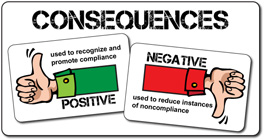
Research shows that classroom disruptions decrease when both positive and negative consequences are used appropriately. In his book, The Art and Science of Teaching, Marzano cites Stage and Quiroz (1997), and Miller, Ferguson and Simpson (1998), who agree that ‘interventions do reduce disruptive behavior’ and call for a ‘healthy balance between rewards and punishments.’

As a believer in “what we focus on grows,” I used to lean more toward positive consequences in my classroom management. However, over the years, I have learned that negative consequences for disruptions or breaking rules are equally important. I fully agree that “a combination of positive and negative consequences appears to be the optimum approach.” (Marzano, 2007)

Apart from establishing a strong relationship with every student, I believe that a teacher should demonstrate a strong sense of what Marzano calls ‘withitness’ in the class. For me, this would mean being aware of what goes on in the class at all times, and responding appropriately. It would include not only noticing when a student is breaking a class rule, but also would mean noticing when students are ‘being good’ and contributing to a positive atmosphere in the classroom.

When students follow rules and procedures, I can acknowledge them by giving positive consequences. Some examples of positive consequences are:

  • When a student follows direction, I could acknowledge it with a verbal or non-verbal cue such as making a ‘thumbs up’ sign, smiling, or saying, ‘Good job.’
  • I can demonstrate awareness when students are following the rules by commenting on it or by thanking them.
  • Positive consequences can also include tangible recognition which involves “providing students with some symbol or token for appropriate behavior.” (Marzano, 2007) This can be in the form of stickers, stars, privileges or other material rewards.
  • Catch them being ‘good’ and reward them with a star or a ‘spot on a dalmation.’ Paste them on a board, and when they get a hundred stars or a hundred and one spots, have a class party to celebrate. 
  • Send positive notes home to parents/guardians, or make positive phone calls.

Marzano lists four actions that would enable a teacher to address behaviors that could lead to problems: Being proactive and taking actions to prevent problems before they occur; occupying the entire room physically or visually; noticing potential problems which would include noticing ‘unusual behavior’ and attending to them; and using a series of graduated actions to stop problem behavior like looking at students, moving closer to them, and if the behavior continues, stopping the class and confronting the behavior. These actions would enable a teacher to intervene before a problem becomes serious.

However, not all behavior outcomes can be predicted. Things do happen in class which require interventions. When students break a rule, or do not follow procedures, I need to respond appropriately.

  • When students do not follow a procedure, I can ask them to show how to do it the right way. For example, if a student runs into the classroom, I can ask the student to demonstrate the correct way to enter our classroom, or when a student speaks rudely, I can ask that student to rephrase the sentence in a polite way.
  • Direct Cost would include losing privileges or time out. An off-task or disruptive student could be given ‘time out’ and asked to complete assigned work during recess.
  • Over correction is perhaps one I would use sparingly and only for more serious offences. For example, if Johnny ‘repeatedly’ forgets to clean his materials after art, I might ask him to clean not only his materials, but his peers’ materials as well.
  • A series of offences would lead to more actions that would help the student to change his or her behavior. It could include contacting the parents or guardians and drawing up an action plan, charts, or checklists.


The following flowchart shows my decision making process in applying rules and procedures in my class:


The following video  from Teaching minute has some concrete examples of giving positive feedback to students who are contributing positively to the class atmosphere: verbal praise, and acknowledging good behavior of individual students as well as the whole class. We also see tangible rewards and rewarding the whole class with a party for good behavior. 


In conclusion, it is important to remember that consequences are used to create an effective learning environment, and should be applied consistently. Appropriate  use of positive or negative consequences will help to preserve students' dignity as well as reinforce desired behaviors.
  

                                        positive and negative consequences


 Resources:

Fritz Redl’s Prevention Strategies for students with emotional Disability. Retrieved from
http://www.blackbinder.com/uploads/3/4/0/9/34090823/cipage1.pdf

Marzano, R.J. (2007). The Art and Science of Teaching. Alexandria, VA. ASCD.


The IRIS Center. (2012). Classroom Management (Part 2): Developing your own comprehensive behavior management plan. Retrieved from https://iris.peabody.vanderbilt.edu/module/beh2/


TeachingMinute: Positive Consequences. Retrieved from
https://www.youtube.com/watch?v=EPRh1FaeqlI