Thursday, 9 March 2017

Applying Classroom Rules and Procedures


“When students do a good job at following rules and procedures, their willingness to be a positive influence in the class should be recognized and acknowledged. Conversely, when students do not follow classroom rules and procedures, their behavior that detracts from learning should be noted. (Marzano, 2007)


If effective learning is to take place in our classroom, I believe a well-managed classroom is a pre-requisite. First, students need to know why we have rules and procedures. They need to know required behaviors for creating a good learning environment. Spending a good amount of time teaching and reinforcing classroom rules and procedures will help a teacher to ensure that the class runs smoothly. Teaching rules and procedures at the beginning of the year and reviewing them periodically over the year will help students to be well-versed with these rules. However, as every teacher knows, there are times when students will break a rule or forget a procedure. What should a teacher do when that happens?                                                
Research shows that classroom disruptions decrease when both positive and negative consequences are used appropriately. In his book, The Art and Science of Teaching, Marzano cites Stage and Quiroz (1997), and Miller, Ferguson and Simpson (1998), who agree that ‘interventions do reduce disruptive behavior’ and call for a ‘healthy balance between rewards and punishments.’

As a believer in “what we focus on grows,” I used to lean more toward positive consequences in my classroom management. However, over the years, I have learned that negative consequences for disruptions or breaking rules are equally important. I fully agree that “a combination of positive and negative consequences appears to be the optimum approach.” (Marzano, 2007)

Apart from establishing a strong relationship with every student, I believe that a teacher should demonstrate a strong sense of what Marzano calls ‘withitness’ in the class. For me, this would mean being aware of what goes on in the class at all times, and responding appropriately. It would include not only noticing when a student is breaking a class rule, but also would mean noticing when students are ‘being good’ and contributing to a positive atmosphere in the classroom.

When students follow rules and procedures, I can acknowledge them by giving positive consequences. Some examples of positive consequences are:

  • When a student follows direction, I could acknowledge it with a verbal or non-verbal cue such as making a ‘thumbs up’ sign, smiling, or saying, ‘Good job.’
  • I can demonstrate awareness when students are following the rules by commenting on it or by thanking them.
  • Positive consequences can also include tangible recognition which involves “providing students with some symbol or token for appropriate behavior.” (Marzano, 2007) This can be in the form of stickers, stars, privileges or other material rewards.
  • Catch them being ‘good’ and reward them with a star or a ‘spot on a dalmation.’ Paste them on a board, and when they get a hundred stars or a hundred and one spots, have a class party to celebrate. 
  • Send positive notes home to parents/guardians, or make positive phone calls.

Marzano lists four actions that would enable a teacher to address behaviors that could lead to problems: Being proactive and taking actions to prevent problems before they occur; occupying the entire room physically or visually; noticing potential problems which would include noticing ‘unusual behavior’ and attending to them; and using a series of graduated actions to stop problem behavior like looking at students, moving closer to them, and if the behavior continues, stopping the class and confronting the behavior. These actions would enable a teacher to intervene before a problem becomes serious.

However, not all behavior outcomes can be predicted. Things do happen in class which require interventions. When students break a rule, or do not follow procedures, I need to respond appropriately.

  • When students do not follow a procedure, I can ask them to show how to do it the right way. For example, if a student runs into the classroom, I can ask the student to demonstrate the correct way to enter our classroom, or when a student speaks rudely, I can ask that student to rephrase the sentence in a polite way.
  • Direct Cost would include losing privileges or time out. An off-task or disruptive student could be given ‘time out’ and asked to complete assigned work during recess.
  • Over correction is perhaps one I would use sparingly and only for more serious offences. For example, if Johnny ‘repeatedly’ forgets to clean his materials after art, I might ask him to clean not only his materials, but his peers’ materials as well.
  • A series of offences would lead to more actions that would help the student to change his or her behavior. It could include contacting the parents or guardians and drawing up an action plan, charts, or checklists.


The following flowchart shows my decision making process in applying rules and procedures in my class:


The following video  from Teaching minute has some concrete examples of giving positive feedback to students who are contributing positively to the class atmosphere: verbal praise, and acknowledging good behavior of individual students as well as the whole class. We also see tangible rewards and rewarding the whole class with a party for good behavior. 


In conclusion, it is important to remember that consequences are used to create an effective learning environment, and should be applied consistently. Appropriate  use of positive or negative consequences will help to preserve students' dignity as well as reinforce desired behaviors.
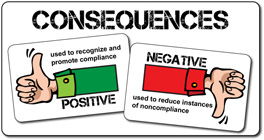
  

                                        positive and negative consequences


 Resources:

Fritz Redl’s Prevention Strategies for students with emotional Disability. Retrieved from
http://www.blackbinder.com/uploads/3/4/0/9/34090823/cipage1.pdf

Marzano, R.J. (2007). The Art and Science of Teaching. Alexandria, VA. ASCD.


The IRIS Center. (2012). Classroom Management (Part 2): Developing your own comprehensive behavior management plan. Retrieved from https://iris.peabody.vanderbilt.edu/module/beh2/


TeachingMinute: Positive Consequences. Retrieved from
https://www.youtube.com/watch?v=EPRh1FaeqlI

Sunday, 18 September 2016

Creating High Performance Learning Environments


The three videos were interesting and fun to watch. I think each teaching style is based on the premise that ‘it’ is the best way to teach in that particular context.

Roller Coaster Physics:

Academic Expectations: This teacher holds her students to high academic expectations. It is evident in the way she assigns work and interacts with the students as they work on their project. The students are researching, discussing ideas, predicting, experimenting and testing their theories on a simulation before the actual experiment. At each step, the teacher is asking questions and pushing them to give reasons for their answers, using appropriate vocabulary. The students are building, measuring, sharing ideas and taking notes. In ‘chiming,’ students discuss the problems they faced and ideas on how those problems can be solved. I think adding constraints to encourage them to become better problem solvers is a great strategy.

Behavior Expectations: It is evident that the students are held to high standards of behavior. All students are engaged in different activities and no one is off-task.

Norms and Procedures: Norms and procedures that build strong performance here is a strong collaborative culture, which is evident in the way they work together, listen to each other as they discuss ideas and take notes. Group members have assigned roles, and each one seems focused on carrying out his/her assigned job. 

3rd Grade Chinese Math:

Academic Expectations: The teacher is delivering instruction based on the belief that “routine practice is the most efficient way to learn.” Kan Wei (2014).  The kids are learning math facts by saying them aloud after the teacher in a rhyming fashion to help them to memorise the facts, though one wonders how much is being absorbed. Whole class instruction and feedback are important components of these classes. I think that due to the rigid regulations and test-oriented education system in China, math teachers are focused on teaching concepts and processes and not so much on real-world applications. However, based on the results, this system seems to work for the Chinese, and when it comes to memorising facts like multiplication facts, perhaps this strategy will work as well as, if not better, than some other strategy that we use in our classes.

Behavior Expectations: The students are expected to pay attention at all times. Chanting the multiplication rhymes would help to keep the children focused and engaged. And most children are willing participants in a group activity. 

 Norms and Procedures: Students are seated in rows, facing the teacher and the board. They raise their hands to speak, and seem comfortable and confident in sharing their answers.

Whole Brain Teaching: This method uses signs, gestures, and verbal responses to get students involved in their learning.

Academic Expectations: The students are held to high expectations because they are constantly kept ‘on their toes’ as they interact with the teacher by way of verbal responses and actions and gestures. The teacher teaches small sections at a time, after which the students teach each other what they learn from the teacher. The teacher will not move to the next section unless he/she is satisfied that all the students have learned the new concept.

Behavior Expectations: Expectations for behavior are very high in this teaching strategy. Students need to listen and pay attention to what the teachers says in order to give the right responses. The class goes over the rules at the beginning of each class. One of the rules is to follow directions quickly. Points are earned for good behavior, or taken away if students do not follow the rules.

Norms and procedures:
This class appears to have well-established norms and procedures. They listen to the teacher and respond with appropriate actions or words. A lot of communication takes place through actions. For example, the action for permission to speak is ‘raise hand and bring down to head and make a talking motion.’

Setting high performance expectations among my students

All three videos employ strategies that are unique and effective in each situation. There are some strategies that I can employ in my upper elementary classroom to create high performance expectations. In the roller coaster activity, the students are actively involved in discussions, note-taking, building, measuring, testing and crystallizing their ideas. All these take place in a positive learning environment where students are encouraged to share their ideas and work together to find solutions. This is a learning environment I would like to create in my classroom.

In the Chinese math class. Students are expected to know their basic math facts, and the teacher employs what she believes to be the best strategy, which in this case, is routine practice. Whole class instruction and practice seem to be the best practice for this. My version of this would be to add some actions as in ‘skip counting.’

I believe there are many ‘take-aways’ for me in the whole brain teaching strategy.  The part I like in whole brain teaching is where the students work in pairs and take turns to teach each other (switch). I think this is a great way to reinforce learning and can be used right after teaching a new concept in math or other subjects. The ‘Class-Yes’ and the other repetitive responses and actions seem to me to be a bit much. But I can see how some of these actions and responses can be useful in a language class or in teaching students with special needs. For example, in geography, drawing a vertical line in the air with your hand for longitude and a horizontal line for latitude might help some students to better understand the concept.

In conclusion, although these are great strategies, I would need to consider the age group and comfort level of my students before using the strategies, especially the ones which involve actions and chanting in unison. Therefore, my first step should be to get to know my students well as only a good knowledge of my students' needs, interests, and abilities would enable me to employ strategies that would create a high performance learning environment that would meet their needs. 


References:
Chen Crystal. 3rd Grade Chinese Math. [Video File]. Retrieved from
https://www.youtube.com/watch?v=h7LseF6Db5g

Migdol, Donna. (n.d.). Roller Coaster Physics: Stem in Action. [Video File]. Retrieved from
https://www.teachingchannel.org/videos/teaching-stem-strategies

Roxishayne. (May 31, 2011). Whole Brain Teaching Richwood High- The Basics. [Video File]. Retrieved from https://www.youtube.com/watch?v=8iXTtR7lfWU&feature=youtu.be

Wei, Kan. (March 25, 2014). Explainer: What Makes Chinese Math Lessons So Good. Retrieved from http://theconversation.com/explainer-what-makes-chinese-maths-lessons-so-good-24380

Whole Brain Teaching. (n.d.). Retrieved from

http://ashleytipton.weebly.com/whole-brain-teaching.html

Sunday, 4 September 2016

Establishing a Positive Classroom Climate


Establishing a Positive Classroom Climate
It is the first day of school. My hands tremble as I grasp the doorknob to open my classroom door and walk into the room I have been preparing for the past few days. The bulletin boards greet me with their colourful displays - some filled with pictures, plans and schedules, and some bare, waiting for the students to fill them with their pictures and work. What does it take to make a room a welcoming and inviting place? Will my students want to sit in this room? Will they want to work here? More importantly, will they want to learn here?
The Classroom Setup:
The first thing the students will notice as they come into the room is how it is set up. It says a lot about how learning will take place. To make it a positive learning environment, I have to think about how my students are going to learn: in groups, whole group and small groups, in pairs, or individually. I have to ensure that every student will have easy access to all the learning materials. The special needs student shouldn’t have to struggle to get to the pencil sharpener in the corner. 
A reading corner, where students can sit on cushions or on a rug, is always a good idea. Bookshelves filled with their favorite books, written by their favorite authors would help them to spend some productive time in this corner. To these, I would add my own selection of books, which would include genres reflecting different reading levels, interests, and cultures.
The Classroom Culture:
Creating a Positive Classroom Culture: What can I do to ensure that every student feels valued and respected in this class?
First, it is important to create an environment in which every student feels safe and secure. Relationship and community- building activities in the first week (and subsequent months) will help students to get to know each other. Games and ice-breakers can be used for students to learn each other’s names, their likes and dislikes, their families, and other details. Putting students in groups for these activities will further help to establish a sense of community.
My students come from diverse cultures, language groups, religions, socio-economic backgrounds and other social constructs that separate and divide people. Scharf (2014), in Critical Practices for Anti-Bias Education, talks about the importance of “genuinely seeing diversity as a strength and an opportunity, rather than as an “issue” or problem.” This diversity in my class gives me an opportunity to teach my students to understand and embrace diversity as it exists in the real world. To prepare my students to live and work successfully in the community, I should help them to appreciate diversity by focusing on understanding each other’s cultures and on what we can learn from, as well as do for, each other.

Making our classroom a safe and secure environment would mean teaching them to respect each other, and treating each other well. While focusing on relationship-building is important, I would also need to educate my students on issues like bullying and other forms of abuse that can happen in schools and communities. In teaching about bullying prevention and intervention, I need to focus on helping them to understand what bullying is, and what everyone needs to do to establish a safe and secure environment in the school; that it is not only about not bullying others, but also stepping in to stop it, or doing something about it when they see it. In addition to educating them on all these issues, I would need to ensure that I never let any disrespectful remark or behavior go unaddressed. Brownstein (2009) calls this ‘zero indifference.’ I need to practice ‘zero indifference.’

Discipline and Behaviour Management: It is important for any class to have a well-thought out and understood system for the way things are done. My students would need to know what the expectations are in reference to behavior as well as completing assigned work. When students have a say in their classroom rules, they will have a sense of ownership, which in turn, will make them more responsible. And with regards to implementing consequences, Sharf (2014) recommends ‘restorative justice’ which emphasizes “repairing harm and restoring relationships rather than simply punishing those who have engaged in misconduct.”

Instruction and the Learning Culture:
Every student in my class comes with different experiences and skills. I have to think of ways to get them to share these experiences and skills.  Researchers report that students learn more from their peers when they work in groups, and as a teacher, I should look for opportunities to let them work on projects and other activities in groups. Working with their peers will enhance their social and communication skills as well.
Keeping in mind the learning styles, capabilities, and interests of the students will help me to craft lessons that will reach every learner. I have to ensure that each culture is addressed and celebrated in our class. Culture, as defined by Scharf (2014), “can refer to an individual’s race, class, gender sexual orientation, religion, immigration status and age, among other things.” Marzano recommends bringing students’ interests- which can include any of the factors listed by Scharf- into content and personalizing learning activities. Knowing the range of diverse cultures in my class will enable me to personalize learning activities and make learning relevant and meaningful for my students by connecting it to their real-world experiences.

How will I as the teacher pull all these threads together to make our time together in this class a meaningful and worthwhile one? Do I know the cultures of all my students? As an Asian teacher, I do not know all the ins and outs and nuances of other Asian cultures, let alone the cultures of other races. I need to educate myself by designing my professional development plans to include learning about the cultures represented in my class, which can and should include parents as a resource.
In conclusion, to create a positive classroom climate for my students, I would need to get to know each one of them. I would need to let them know that I’m interested in them as individuals, and that their interests and dreams matter to me. A positive attitude will help me to get the message across that I enjoy having them in my class. I can show them that I care by showing respect, trust and a caring attitude. Teacher-student relationship, according to Marzano is the ‘keystone’ of effective management, and that “teacher behavior is the language of that relationship.” There’s so much that I need to learn.
For now, I will begin by greeting them at the door.

References
Brownstein, Rhonda. (2009) Pushed Out. Retrieved from
http://www.tolerance.org/pushed-out

Scharf, Amy. (2014). Critical Practices for Anti-Bias Education. Montgomery, Alabama. Teaching Tolerance.

 Marzano, R.J. (2007). The Science and Practice of Teaching and Learning. Alexandria, VA. ASCD.


Saturday, 27 August 2016

Making a Case for Mobile Devices


Why should a teacher be prepared to allow or require students to use mobile devices to achieve learning objectives?

 Mobile learning can and does make a positive difference in how students learn, and it’s not just because of the “cool” factor. When used the right way, mobile technology has the potential to help students learn more and comprehend that knowledge.” (Matthew Lynch, 2015)

One of the areas in which our world is hurtling toward the future is in the area of technology. Innovations in digital learning, though a tad slower, is making great progress as well. One way, we as teachers, can move forward with the rest of the world is by using mobile devices in our classes. Why mobile devices? Referring to the iPad, Marc Prensky points out “the incredible flexibility it provides to vary learning activities at a moment’s notice,” and that “with iPads students have the world at their fingertips– anywhere they might be.” One can say the same thing about other mobile devices. In one small device, students have access to an unimaginable amount of resources, and teachers need to be looking into how to tap those resources to enhance student engagement and improve learning. On students’ use of mobile devices, Lynch notes: “They stay on task, they correct mistakes in real-time and, most importantly, they get excited about learning.”

What’s great about mobile devices?
  •          Ability to collaborate by interacting with peers anytime and anywhere.
  •         Students own them and are using them in multiple ways.
  •          “Mobile learning lets students benefit from interacting with their course content on the devices that they use to connect with every other aspect of their lives, nearly 24/7.” (Wilson et al)
  •          If the school cannot provide them, students can bring their own.


Some learning strategies and activities that would work well with mobile devices:
  •          Watching a short YouTube video
  •          Game-based activities
  •         Writing and sending short messages/email
  •          Sharing thoughts and ideas
  •          Taking and sharing pictures
  •          Scavenger hunts
  •          Drawing mental images and sharing them
  •          Reading e-books
  •          Listening activities


Guiding Principles for using mobile devices:

Clear objectives: Clear objectives are imperative because students can easily get distracted and lost in the world out there.

Structure and Control: An effective approach can provide control.

Short and to the point:
“2-minutes: for reinforcing information via interactive knowledge checks and updating existing information.
5-minute: for interactive learning games and short videos that communicate information.
10-minutes: high-level interactive games and integration of social learning.”                                  
                                                                                                    (Designing Digitally, 2016)

Simple navigation and user friendliness: “Easy to follow navigation is key in mobile learning.” (Chaffe, 2016)


Other factors to consider:

·         Personalised: First, personalised learning, which considers the learning style, interests, and abilities of each child should drive every learning task. Differentiated instruction which according to Tomlinson, “means tailoring instruction to meet individual needs,” will help our students to work at their own pace, “taking extra time in the areas where they need it most.” (Lynch, 2015)

·         Communication: We cannot let our students loose on the internet without teaching them how to communicate in an appropriate manner.

·         Creativity: The main focus should be on creating meaningful and innovative experiences for students. Perhaps, student-driven should be the guiding factor here.


Some activities that I would consider using in my class:

Mobile Devices: Phone, iPad, camera, tablet

Write-Draw-Share
  • After reading or listening to a story, students could use a mobile device to write a descriptive paragraph or draw a mental image of their favorite character. 
  • They could then share it with their peers and teacher using an app of their choice on their mobile device.


Write and Punctuate: 
  •          Students should learn to communicate in a clear and concise manner.  Students could use mobile devices to send messages to each other focusing on not just text, but punctuation as well. Whether they type their message or use voice to text, they still need to know the punctuation rules.
  •       After a language lesson, students could practice what they have learned by posting messages on a shared platform. 

·        
Scavenger Hunt: There are countless possibilities for this activity ranging from taking photos to looking for specific information, places, shapes, or objects. 
  •          A geometry activity could have students looking for different shapes and objects and taking photos and sharing them.
  •          History students are sure to enjoy hunting for historical objects or monuments in their area or in another country.
  •          Scavenger hunts need not be confined to our world. Students could use their devices to look for stars and other heavenly bodies.


Some factors to keep in mind:

Connection speed and data plan limitations: This will be an issue, and we cannot expect all our students to have fast internet connection or be connected all the time.

Digital divide: The way the world is moving toward digital innovations and tech use is mind- staggering, but the reality is that there is so much inequality in this world that many children can only dream of owning a mobile device.

Expectations - What the experts say:

“Simply using mobile technology in the classroom does not guarantee a rise in comprehension or even the attention of students. “(Lynch, 2015)

“You cannot directly take a computer-based learning method and transfer it to a mobile device. The manner in which we learn from mobile devices is different from computer-based learning or traditional classroom-setting learning.” Designing Digitally, Inc.

“Face to face or computer-based learning should not be just automatically converted for delivery to a mobile device.” (Chaffe, 2016)


In conclusion, despite the evident benefits of using mobile devices in the classroom, we should not ignore the fact that we can never predict the direction a mobile device activity could take. Often, there is a big gap between the ideal and reality, and a good knowledge of our students as well as the activity is critical to ensure a positive and successful experience for all.


References:

Chaffe, Sophie. (March 5, 2016). Getting Mobile Learning Right: 6 Best Practices. Retrieved from https://elearningindustry.com/getting-mobile-learning-right-6-best-practices


Lynch, Matthew. (March 31, 2015). Do Mobile Devices in the Classroom Really Improve Learning Outcomes? Retrieved from http://theconversation.com/do-mobile-devices-in-the-classroom-really-improve-learning-outcomes-38740

Prensky, Marc. (December 2, 2005). Shaping Tech for the Classroom. Retrieved from http://www.edutopia.org/adopt-and-adapt-shaping-tech-for-classroom

Wilson, E., Kelleher, J., Day, L., Hives, L., and Lilleker, R. (n.d.). Getting Started with Mobile Learning. Retrieved from http://www.blackboard.com/cmspages/getfile.aspx?guid=0b434794-81ec-4eae-9367-6498052a66e0


Sunday, 14 August 2016

Cognitive Flow and Learning
By Zalino Bona

An activity that gets me into that state where I’m totally immersed and lost to the world, is reading. Suspenseful books have that effect on me. Another activity that can take me to a new world is crafts; especially when I’m creating something. Egg decorating, knitting, sewing and making things with fabric or paper get me into that state where I’m so caught up in what I’m doing that eating and sleeping can seem like distractions.                                                                               

 Mihaly Csikszentmihalyi calls this state of engagement ‘flow.” He describes the flow experience as: “when a person is completely involved in what he or she is doing, when the concentration is very high, when the person knows moment by moment what the next steps should be …” For Jill Suttie, it is “that feeling of complete immersion in an activity, where we’re so engaged that our worries, sense of time, and self-consciousness seem to disappear.” 

                                            Image result for cognitive flow images

When I am engaged in an activity like egg decorating, for example, I think of a design in my mind, and I use different materials and work with the goal of transferring the design in my mind to the eggshell. I get instant feedback as I see the plain eggshell being transformed into a multi colored object with swirls, lines or other geometric designs. The challenge lies in working with tiny beads, paint, yarn and other materials on a fragile eggshell, while trying to create something aesthetically pleasing and as perfect as possible.

Why do I experience flow when I am engaged in an activity like this? It is hands on and challenging. I can increase the level of challenge by changing the material or making the design more intricate. There are clear goals and feedback, and I enjoy working on it. All these conditions foster flow, according to Jill Suttie. The conditions for flow, according to Csikszentmihalyi are clear goals and feedback, and the right level of challenge: “ the feeling that what you can do is more or less in balance with what needs to be done, that is, challenges and skills are pretty much in balance.”According to Csikszentmihalyi, Suttie and others, hands on activities, rather than lectures, the right level of challenge which requires a good balance between the challenge of the activity and the skills of the person engaged in that activity, team projects, and giving a wide array of choices can be powerful motivators. And when students can connect what they are learning in the classroom to their own lives, they’re more likely to be more invested and engaged.

A wise mentor once said that “technology is useful because it enables us to know and access what’s out there so we are not reinventing the wheel.” The internet has tons of ideas on all the things I love to do. My personal learning network contains a list of resources that I could dig into for ideas and suggestions. Some sites that I love to explore and turn to for ideas are:
www.hobbycraft.co.uk

If flow helps me to take learning to a deeper level, as a teacher, I believe this is an area I should be exploring to make my lessons more meaningful to students and to take them to new levels of learning. I need to explore ways to create conditions that foster flow in my class to enable my students to engage with their lessons to enhance their learning experiences. 

I also need to be aware of things that could get in the way of flow: not having needed materials at hand, lack of time, and distractions in the form of other people trying to talk to us when we are trying to concentrate. Jill Suttie lists the constrains of public schools: rigid curriculum, testing, grades, and time limit as obstacles to flow in classrooms.

Finally, though watching videos is reportedly not an activity that fosters flow, it is one of the best ways of gaining knowledge. So, here’s a video which will hopefully help us to learn more about this process called flow: What the Science of Flow can Teach us About Limitless Performance.


Resources

Mihaly Csikszentmihalyi: Motivating People to Learn. (April 11, 2002). Retrieved from http://www.edutopia.org/mihaly-csikszentmihalyi-motivating-people-learn

Suttie, Jill. (April 16, 2012). Can Schools Help Students Find Flow? Retrieved from http://greatergood.berkeley.edu/article/item/can_schools_help_students_find_flow


Suttie, Jill. (April 7, 2012). Eight Tips for Fostering Flow in the Classroom. Retrieved from 
http://greatergood.berkeley.edu/article/item/eight_tips_for_fostering_flow_in_the_classroom

Sunday, 24 July 2016

Strategies for English Language Learners


Next term, I am likely to teach a Grade 4 science class on Magnets. Here’s a plan and some specific strategies on how I will teach this class. There are four English language learners at different levels in the class:
-          Rina: Early Production Stage
-          Zak:  Speech Emergence Stage.
-          Toni: Intermediate Fluency Stage
-          Rai: Advanced Fluency Stage

Unit: Magnetism
Lesson Objectives: The student will
-           Know vocabulary: magnet, magnetic, poles, repel, attract, and magnetic field.
-          Understand that magnets have poles
-          Understand the concept of attraction and repulsion
-          Understand that some materials are magnetic and some are not
-          Explore further: Uses of magnets

Video: Magnetism-The Dr. Binocs Show (3 minutes) https://www.youtube.com/watch?v=yXCeuSiTOug
Learning Center Activities: Magnetism Fishing, magnetic car race, etc.

All students will be required to know and define vocabulary for this lesson, as vocabulary and language development are important at all levels. Students can use flashcards or an online app to work on vocabulary. To differentiate instruction, the needs, abilities and interests of all four students will have to be taken into consideration. It should also be ensured that all students achieve the lesson objectives while building their English language skills.


All students will watch the video, then take part in exploring how magnets work at learning stations. In this guided interaction, students will discuss the results and verbalize their observations. Students will use graphic organizers like K-W-L chart and note-taking templates as the use of graphic organizers and visuals help students to think about what they are learning. All students will participate in a ‘Share what you have learned’ session.

Rina, who is at the Speech Emergence level, is beginning to use simple and short sentences. Retelling what she has learned or using the magnets to show how they attract or repel, will demonstrate her understanding of the lesson.

At the Beginning Fluency level, Zak is able to speak fairly well in social situations. However, new contexts and academic language still pose a challenge for him. In this lesson, he will be asked to give full answers to some questions, work on a ‘fill in the blanks’ worksheet, (with answers provided) and give a short oral presentation on ‘How magnets attract and repel.’

Toni, at the Intermediate fluency Level communicates ideas and thoughts fairy well in social situations,  but vocabulary and new contexts can still be a challenge  for her. Writing down her observations and doing further research on uses of  magnets will help her to understand more about the topic. 

Rai, at the Advanced Fluency stage, communicates fluently and faces all tasks efficiently and confidently. He will do further research on the internet and create a poster on the topic: Uses of magnets and why they are useful.

All students will benefit from mixing freely, experimenting and talking to peers about the activities, and using the right vocabulary when sharing their thoughts and ideas. Thinking about how magnets are used in their everyday lives will help the students to connect what they are learning to their lives (meaning- based context). 


Resources
Hynes, Judy. (2005). Stages of Second Language Acquisition. http://www.everythingesl.net/inservices/language_stages.php

Hill, Jane D. and Byork, Cynthia L. (2008). The Stages of Second Language Acquisition. Retrieved from http://www.ascd.org/publications/books/108052/chapters/The-Stages-of-Second-Language-Acquisition.aspx

Six Key Strategies for Teachers of ELL. (December, 2005) New Teacher Center. Retrieved from
https://docs.google.com/gview?url=http://suu.edu/ed/fso/resources/esl-six-key-strategies.pdf